Top Signs You Need Garage Door Service – Don’t Ignore These
A garage door that takes three seconds longer to open than it did six months ago isn’t “just getting old.” It’s usually telling you the spring tension is off, and you may be weeks away from a full spring failure that traps your car inside. Most garage door breakdowns don’t happen out of nowhere. They announce themselves first through sounds, movements, and visual changes that homeowners write off as normal. The trick is knowing which warnings are safe to watch and which mean calling someone today.
Here’s the direct answer: the signs that most reliably mean you need service are a door that moves unevenly or reverses on its own, a loud pop followed by a door that won’t lift, grinding or squealing that’s getting worse, a visibly sagging top panel, and any opener that works only some of the time. If any of those describe your door in Delray Beach, the safe move is to stop using it and get it looked at. If you’d rather not DIY, call (855) 393-4914 and we’ll take a look.
What the Sounds Are Telling You
Sound is the earliest and cheapest diagnostic tool you have. Each noise maps to a different failure, and a few of them are maintenance-level while others are warnings to stop using the door.
- Squealing or high-pitched whining: Usually dry rollers, hinges, or a dry torsion tube. This is maintenance-level. Lubrication and adjustment handle most cases.
- Grinding: Metal-on-metal. Often worn rollers, a bent track, or a failing bearing. It gets worse fast, and it can chew up the track if you ignore it.
- Popping or a single loud bang: This is the one to take seriously. A snap or pop followed by a door that suddenly feels very heavy usually means a torsion spring has broken. Stop operating the door. Springs are the most dangerous component in your garage door system, and a door with a broken spring can come down hard under its own weight.
- Rattling over the whole cycle: Loose hardware or a worn opener chain. Annoying more than dangerous, but worth tightening before it loosens something else.
In our experience, the pop gets ignored more than any other warning because the door sometimes still opens once or twice afterward. It won’t keep working. A spring that’s snapped doesn’t repair itself, and every extra cycle puts more load on the opener motor and the cables. When we’re called out on garage door repair in Delray Beach, a broken spring is the most common reason, and the pop is almost always the first thing the homeowner mentions.
The 30-Second Balance Test
You can catch spring wear before it becomes a breakdown with a quick test that takes half a minute. This is a check, not a repair. Do it once a month or anytime the door feels heavier than usual.
- Close the door and pull the opener’s manual release cord so the door is disconnected from the motor.
- Lift the door by hand about halfway up, then let go.
- Watch what it does.
A healthy door stays put, roughly where you left it. If it sags back to the floor or drops under its own weight, the springs have lost tension and are on their way out. If it drifts upward, something’s over-tensioned. Either result means it’s time for service.
One important note: the balance test tells you the springs are the issue. It does not tell you to go adjust them yourself. Torsion springs are under extreme tension, and the tools and technique to wind them safely aren’t something to improvise. That part is for trained technicians. Handle the test, then make the call. Running the balance test on a door in Delray Beach where the springs carry a full load every single day is a smart habit, because the springs do the heaviest lifting in the whole system.
Visual Signs That Matter Here
Your eyes will catch problems your ears miss, and in Delray Beach’s heat and humidity, a few specific clues show up more often than they do in cooler, drier climates.
- Rust streaking on the cables: Look along the lift cables for orange or brown stains. Rust weakens the cable, and cables carry the door’s full weight alongside the springs. A frayed or rusted cable is a stop-using-the-door sign.
- White mineral deposits on the rollers: That chalky film comes from humidity condensing and drying repeatedly. Combined with a dry roller, it accelerates wear. Lubrication helps, but once a roller is pitted it’s better replaced.
- Cracked or crumbling bottom seal: The sun degrades the rubber over time, and a failing seal lets water and pests under the door. It’s an easy swap and worth doing before rainy season.
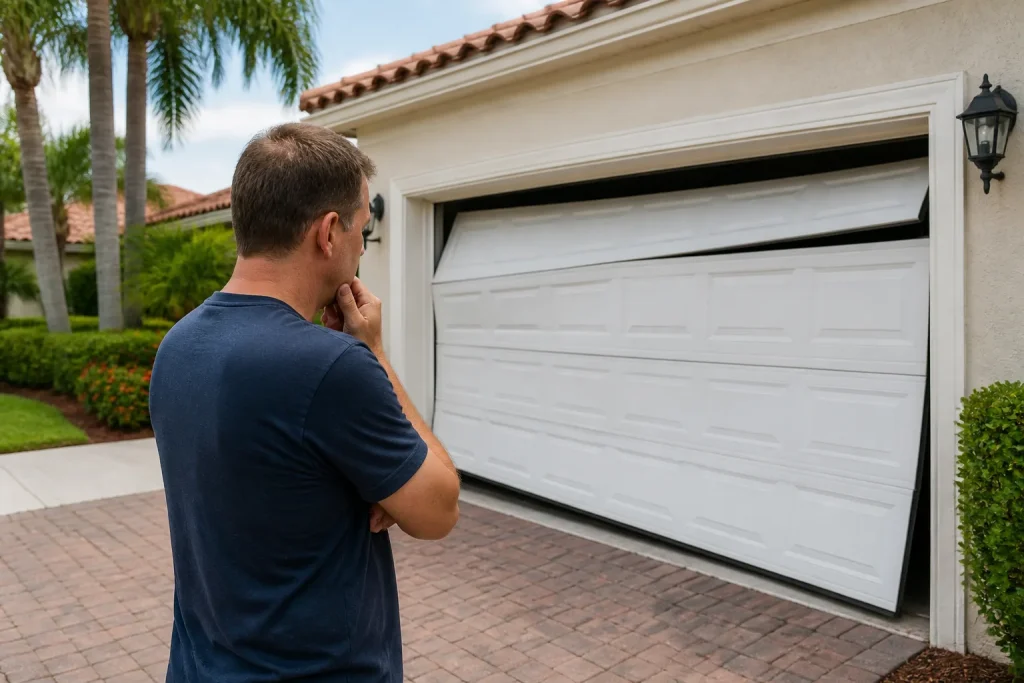
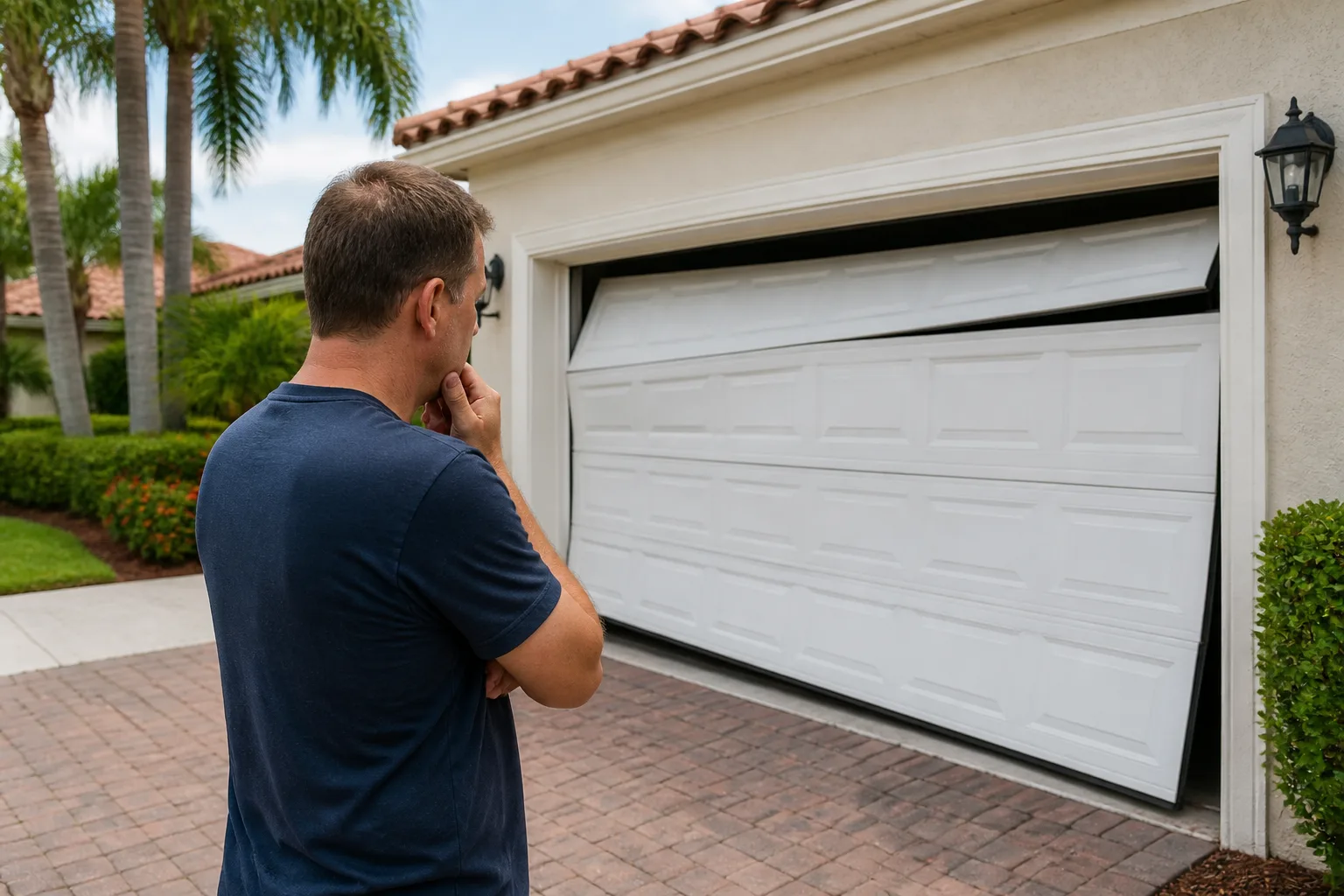
- A sagging top panel: If the top section bends or bows, the door has been fighting the opener or a failing spring. Panels from brands like Clopay and Amarr hold up well, but a bent panel won’t straighten itself and often needs replacing.
- Uneven gaps: When one side of a closed door sits lower than the other, the door is racking. That’s usually a track or cable problem in progress.
Delray Beach’s warmth speeds up seal wear more than you’d think, and same-day garage door repair in Delray Beach often starts with a bottom seal that gave out months earlier and was quietly letting humidity do damage underneath. A five-minute walk around the door once a season catches most of this before it gets expensive.
When the Door Reverses: Two Problems, Not One
Homeowners often lump these together, but a door that reverses for the wrong reason tells you which fix you’re in for. The behavior tells you the diagnosis:
- The door reverses before it reaches the floor: This is a safety sensor issue. The optical sensors near the bottom of the track have been interrupted, misaligned, or have dirty lenses. This is a safety feature working as designed, but a sensor that trips on nothing is a nuisance, and a sensor that’s been forced or taped over is a hazard. Clean the lenses and check that they’re facing each other. If that doesn’t fix it, it’s a sensor or wiring fault.
- The door reverses immediately after touching the floor: This is a limit switch or force-adjustment issue. The opener thinks the door has hit an obstruction or that the door’s down-limit is set too deep. Too much force setting has the opposite problem: the door won’t reverse on contact, which is exactly when a child or a pet can get hurt. We treat a wrong force setting as a safety problem, not a convenience one.
Both fixes are quick once you’ve identified which one you have. The difference in the symptom is the whole diagnosis. On a door in Delray Beach that opens and closes many times a day, a sensor that’s drifted slightly out of aim is common, and it’s one of the simpler calls we handle for garage door opener repair in Delray Beach. If your opener is a LiftMaster or Chamberlain unit with auto-reverse logic, the fix is often adjustment rather than parts. If your door uses a Genie opener, the force settings are adjusted differently, and a technician who works on those units every week knows the sequence.
Why an Intermittent Opener Is the Riskiest Sign
An opener that works most of the time is the sign people most often ignore, and it’s the one that scares us most. Not all failures are equal:
- Fails safely: The opener just stops. The door stays closed. You’re locked out of the car, but nothing drops.
- Fails dangerously: The opener hesitates, the door jams and the motor holds, a limit switch misreads, or a broken spring leaves a heavy door on a weak opener. In some of these cases the door can come down fast instead of staying put.
Intermittent behavior usually means a worn gear, a failing logic board, a loose connection at the opener head, or a door binding in its track and confusing the opener’s force sensor. Each of those can go from “sometimes” to “won’t lift” without warning. The safe move is to stop treating a sometimes-opener as a normal thing. Our technicians have up to 10 years of experience diagnosing these, and we’ve learned that the “it works, mostly” call is the one that turns into a stuck door with a car trapped inside. When an opener in Delray Beach starts behaving unpredictably, calling before it quits is far less stressful than calling after.
When to call a pro
Call us rather than DIY if any of these are true: the door has popped and stopped lifting, a cable looks frayed or rusty, the door reverses on its own, you’ve had to pull the manual release to get the car out, or your balance test failed. Springs, cables, and opener force adjustments carry real injury risk, and the small savings from doing it yourself isn’t worth a hand or a dropped door. Call (855) 393-4914 for a free estimate.
The Bottom Line
Most garage door failures give you weeks of warnings first. The squeal, the pop, the slow lift, the streaks on the cables, the door that reverses after touching down, the opener that acts up only sometimes – each of those is a sign with a specific meaning and a specific fix. Catch them early and you’re dealing with lubrication and adjustment. Ignore them and you’re dealing with a broken spring, a fallen door, or a car stuck in the garage at the worst possible moment.
If you’re in Delray Beach and need help, Delray Beach Garage Door Repair Pros offers free estimates – call (855) 393-4914. We work on the brand you already have across LiftMaster, Chamberlain, Genie, Clopay, Amarr, Wayne Dalton, Craftsman, and Raynor, from a squeaky roller to a brand-new door from Clopay, Amarr, Wayne Dalton, or Raynor.
Frequently Asked Questions
The earliest signs are usually sound and movement: squealing, grinding, a door that opens slower than usual, or a door that drifts instead of holding its position during a balance test. A single loud pop with a door that won’t lift is a broken spring and needs a stop-use call. If you notice any of these in Delray Beach, call (855) 393-4914 for a free estimate.
No, and it isn’t worth trying. Torsion and extension springs are under extreme tension, and the tooling and technique to safely adjust or replace them are what trained technicians carry. We treat spring work as the highest-risk part of the job for that reason. Call (855) 393-4914 and we’ll handle it.
Usually not. A door that reverses before reaching the floor is a safety sensor issue. A door that reverses after touching the floor is a limit switch or force adjustment problem. Both need a technician, but the fix is different. Call (855) 393-4914 for an exact quote – estimates are free.
Run the 30-second balance test once a month, and do a visual walk-around of the cables, rollers, and bottom seal every few months. In Delray Beach’s heat and humidity, seals and rollers wear faster, so a quick check before and after the hot season catches most problems early. If something looks off, call (855) 393-4914 for a free estimate.
Written by the team at Delray Beach Garage Door Repair Pros.
Need Garage Door Help?
Call Delray Beach Garage Door Repair Pros - the local pro we connect you with is licensed and insured, here with fast after-hours help in Delray Beach.
(855) 393-4914